Proven Physics: Vetted by Law & Deterministic Simulation
UK IPO examiner-confirmed inventive claims, custom first-principles 60 Hz digital twin validation, and accelerated Green Channel priority.
Our Intellectual Property Portfolio
Independent Validation & Defense
OGPEG has built a protected, proprietary IP foundation around its core architecture. Rather than relying on conceptual theory or off-the-shelf software, our technology is backed by custom 60 Hz physics modeling and formal patent examination.
Our multi-mass vector control claims were fast-tracked under the UK IPO Green Channel - a specialised pathway reserved for environmental technology. Following detailed examination, the senior UK IPO examiner officially confirmed our core mechanical claims as "definitely inventive."
Our Core Filings & Status Enclosures:
Gravitational Mechanical Energy Generator (GB2644938)
Timeline: Filed 25 September 2023 | Published 24 June 2026.
What it covers: The foundational mechanics and architectural design of our physical gravity generation core.
Official Registry Access: [Download Official Publication PDF]
WIPO Publication: [Download Official Publication PDF]
Integrated Energy Management, System Recharge and Grid Stabilisation System for Gravitational Mechanical Energy Generators (GB2702026)
Timeline: Filed 31 January 2026 | Published 27 May 2026.
What it covers: Our smart power management architecture, how the track loops recharge momentum, and how the machine maintains continuous rotational momentum and delivers steady physical H-constant inertia to the grid.
Official Registry Access: [Download Official Publication PDF]
Method for Managing and Extracting Non-Linear Parallel Force Vectors in a Gravitational Mechanical Energy Generator Track (GB2702820)
Timeline: Filed 9 February 2026 | Published 01 July 2026.
What it covers: The core mathematical and mechanical path control used to harvest continuous rolling force (Fp) along our custom track angles.
Official Registry Access: [Download Official Publication PDF]
Dynamic High-Rigidity Containment and Stabilisation System for Gravitational Mechanical Energy Generators (GMEG) (GB2603187.2)
Timeline: Filed 11 February 2026 | Status: Pending.
What it covers: The heavy-duty, high-rigidity structural stand and housing frameworks designed to hold the machine perfectly stable under heavy moving loads.
Official Registry Access: [Pending]
Vetted Under Senior Patent Office Scrutiny
Accelerated Green Channel clearance confirming classical physics, non-obvious mechanical innovation, and strict thermodynamic compliance.
Rigorous Technical & Prior-Art Examination
Our intellectual property portfolio has undergone direct examination by a senior examiner at the UK Intellectual Property Office (UK IPO) - evaluating our vector calculations, closed-loop energy management, and structural mechanics against strict international standards:
- Green Channel Clearance:
Fast-tracked under the environmental Green Channel, successfully navigating prior-art searches and securing examiner consensus on core inventive claims. - Zero Oppositions:
Navigated examination with zero third-party oppositions or invalidation challenges. - Classical Mechanics Validation:
Confirms that GMEG-Zero operates entirely within established classical mechanics and thermodynamics - providing institutional investors with total confidence in our physical physics, legal defensibility, and freedom to operate.
Custom Dynamic First-Principles 60 Hz Python/LaTeX Digital Twin
Evaluating over 199,000 data points per complete dual-cycle across 61 live telemetry variables at 16.667 ms resolution.
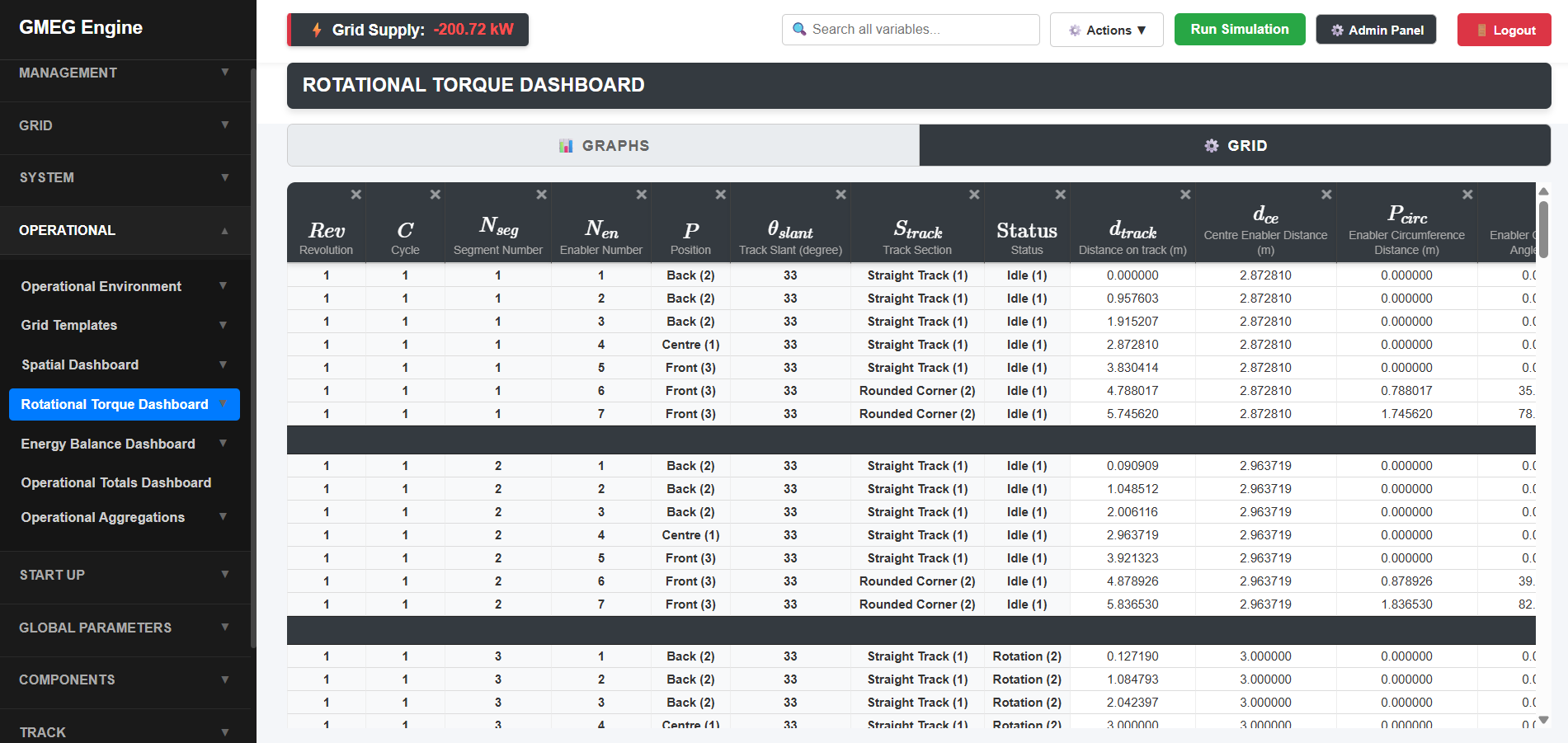
Why We Built Our Own Simulator
Off-the-shelf industrial tools cannot resolve multi-mass weights moving along a dynamically tilting track. To completely de-risk physical manufacturing, OGPEG built a custom 60 Hz physics engine to model every force, stress, and variable in Python and LaTeX before cutting steel.
The 3 Live Performance Dashboards
- Spatial Dynamics Matrix:
Tracks mass positions along the track in real time to calculate precise Track Arc Rotation (± 30°) trigger points and smooth transition timing. - Torque & Vector Transformation Grid:
Calculates real-time force vectors (Fp = mg sin θ) across all masses. Resolves net drive torque, sets reset motor load requirements, and models continuous physical inertia (H-constant). - Energy Balance Accounting Loop:
Tracks continuous system energy in real time - balancing gravitational energy input against mechanical friction, motor power draw, and supercapacitor recovery across both startup and steady-state operating speeds.
Simulated Engineering Bounds & Structural Tolerances
Digital Twin stress-testing across peak torque vectors, structural flex limits, and continuous grid export.
1. Dynamic Structural Rigidity (≤ 0.075 mm Flex Limit)
Finite Element Analysis (FEA) integrated within our 60 Hz simulator confirms that during peak torque transitions, the track frame maintains an ultra-strict deflection limit of ≤ 0.075 mm. This rigidity prevents structural fatigue, ensures perfect bearing alignment, and guarantees a 30-year operational life.
2. High-Torque Realignment Mapping (>1,000,000 Nm)
Our simulation engine resolves microsecond force curves during track tilts, handling peak realignment torque in excess of 1,000,000 Nm across active ± 30° angles. This stress data directly sizes our reset motors, actuators, and slewing bearings to absorb peak loads safely.
3. Closed-Loop Multi-Vector Balance
The Digital Twin models real-time mass dynamics across 3 distinct power inputs and 4 internal recovery outputs simultaneously. By balancing forces down to the microsecond, the control logic neutralizes torque spikes, protects internal drive components, and delivers a smooth, steady H-constant anchor directly to the grid.